
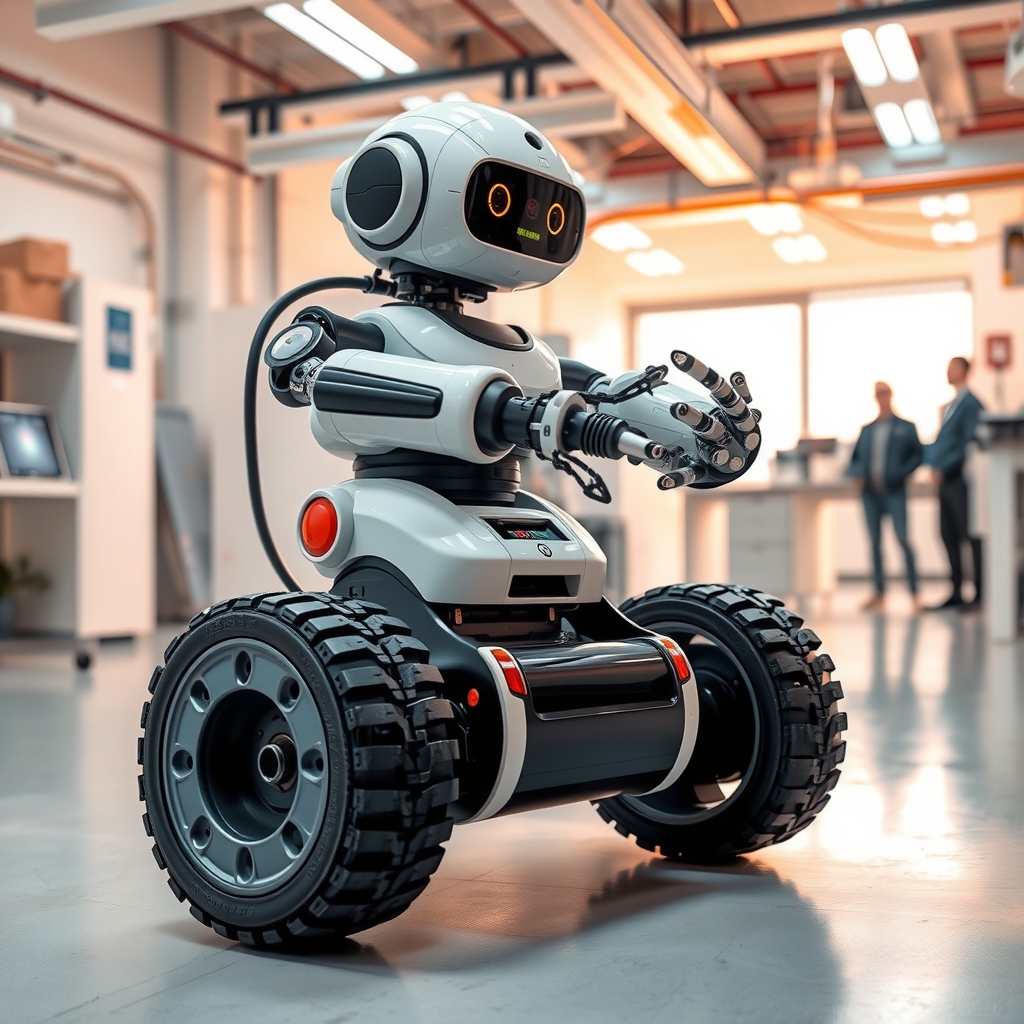
Paris-based Genesis AI has raised $500 million in a Series A funding round to advance its general-purpose robot, Eno, and the artificial intelligence system designed to control it. The round values the company at $3.5 billion, according to the announcement details.
Premji Invest, Khosla Ventures and Eclipse led the financing. Investors also included the venture capital arms of Nvidia, Advanced Micro Devices, Zoom Communications, Samsung Electronics and Ericsson. Former Google Chief Executive Eric Schmidt and other technology executives participated.
Genesis says it will use the new capital to hire additional AI researchers and robotics specialists and increase the collection of training data. The company says those efforts are intended to expand the capabilities of its model and support deployment of its robots in real-world settings.
A wheeled platform designed for varied tasks
Eno differs from humanoid robots that move on two legs: it uses a wheeled base. The platform can change the robot’s height through a mechanism made of two large panels joined by a hinge. Genesis describes that adjustable configuration as a way for Eno to adapt to different tasks.
The robot’s hands are central to the company’s approach to training. Genesis designed its palms and fingers to closely resemble a human hand, allowing the robot to learn from demonstrations of people performing tasks by hand. The company says human demonstrations are easier to produce than footage of robots completing the same work, which can help address a data-collection challenge in robotics.
That challenge arises because training material needs to correspond to the robot that will use the model. A dataset for a four-legged robot, for example, needs to include demonstrations involving four-legged robots. Collecting enough examples can become harder as a robot’s design and capabilities become more specialized. Genesis is seeking to reduce that dependence on robot-specific footage by using hand demonstrations that can be gathered from people.
Eno’s hands have 20 degrees of freedom, compared with 27 in a human hand, and are covered with a soft material designed to mimic skin. The company’s design combines a human-like form with a robot-specific range of motion, providing the physical interface through which the system can handle objects and perform manual tasks.
GENE model and demonstrations
Eno is controlled by GENE, a custom AI model that Genesis describes as a foundation model for robotics. The company says GENE is easier to train than traditional neural networks optimized for robotics and that this can lead to higher output quality. Those are company claims; the available details do not include independent benchmark results or measurements for comparing the model with alternatives.
Genesis has published demonstration videos showing the system playing piano, cooking and solving a Rubik’s Cube. The company says the model can carry out tasks involving dozens of steps, and presents the range of demonstrations as evidence of its goal of building a robot usable in both industrial environments and homes. The examples illustrate different kinds of manipulation, but do not establish how reliably or quickly Eno can perform them outside demonstrations.
The company’s co-founder and CEO, Zhou Xian, said Genesis is building the robot itself so it can improve the system in a “closed loop,” refining the robot’s components and the AI together. Xian said the funding would accelerate efforts to deploy robots at scale. Genesis has not provided a deployment schedule in the details of the funding announcement.
The financing brings together investors with interests spanning chipmakers, communications and electronics companies, alongside venture firms and individual technology executives. Genesis’s immediate stated priorities are expanding its team and gathering more training material. The progress of those efforts will shape how broadly GENE can be trained and whether Eno’s capabilities can extend beyond the tasks shown in the company’s demonstrations.