The global installed base of connected mining solutions is forecast to grow from 1.5 million units in 2025 to approximately 3.1 million by 2030, according to research firm Berg Insight. The projection represents a compound annual growth rate of 15.3% over the five-year period.
The expansion reflects mining operators’ use of connected technology across equipment, worker safety and site conditions. Applications range from vehicle telematics and autonomous haulage to personnel monitoring and environmental sensors. Berg Insight’s market analysis groups solutions into equipment, people and environment segments.
Mining connectivity reaches beyond fleet tracking
Equipment accounts for the largest share of connected mining deployments. This category includes original equipment manufacturer telematics on vehicles and machinery, as well as systems supplied by specialist technology companies. People-focused solutions support worker safety and productivity, while environmental systems use sensors to monitor conditions at mining sites.
Applications covered in the analysis include proximity detection, collision avoidance, fatigue monitoring, situational awareness and ventilation on demand. These uses point to a wider role for connected systems: alongside tracking assets, they can provide information relevant to safety and operational decisions.
Asia-Pacific has the largest share of connected mining deployments, followed by North America, Latin America, Europe, and the Middle East and Africa, according to Berg Insight. The regional spread reflects a market that includes different operating environments and technology needs, rather than a single uniform deployment model.
Autonomous haulage is an established application
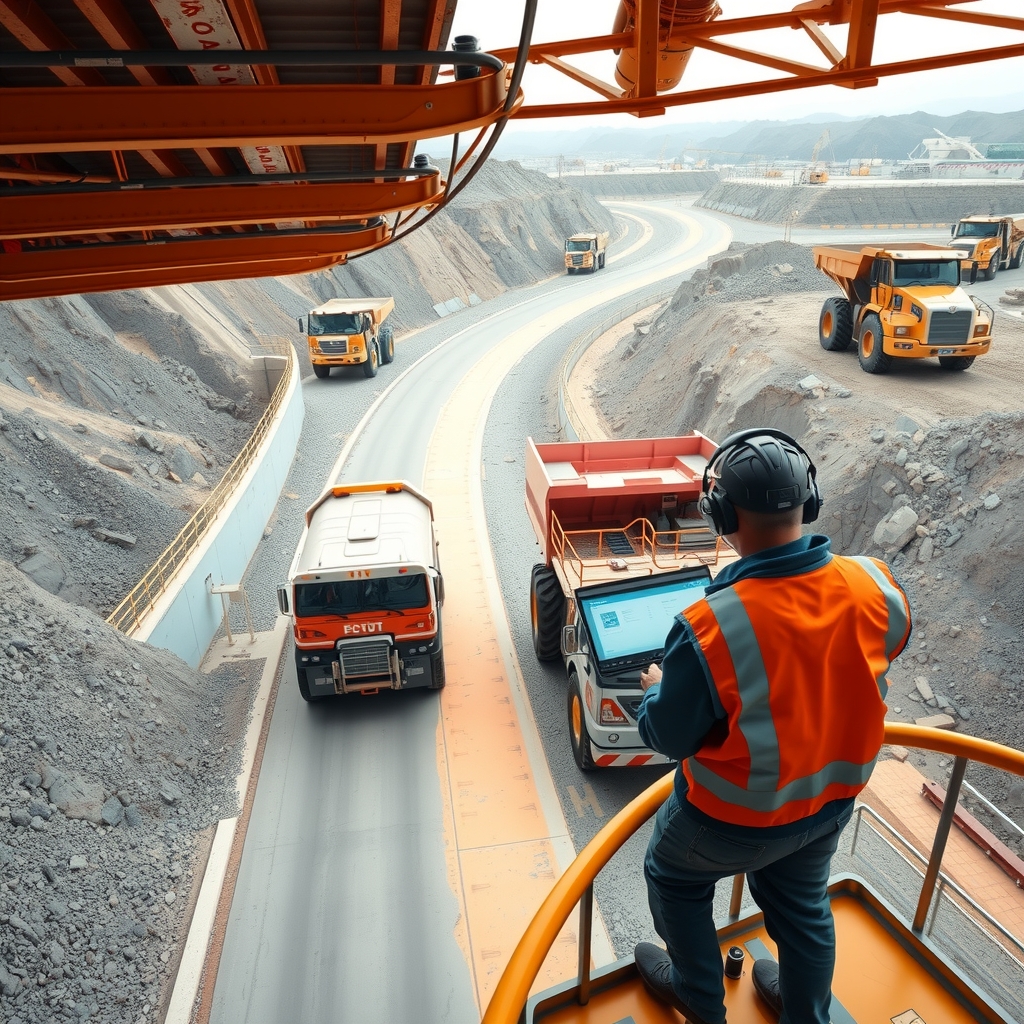
Berg Insight estimates that about 9,000 autonomous haulage trucks were operating in surface mines worldwide as of the fourth quarter of 2026. Asia-Pacific leads in deployments, with China the largest market, followed by Australia.
Komatsu and Caterpillar each have substantial autonomous fleets, with more than 1,000 and 800 mining trucks in operation, respectively. Chinese technology provider Eacon reported that 4,000 active mining trucks were using its autonomous haulage system by November 2026. The figures illustrate how autonomy suppliers can provide systems for vehicles made by other companies, distinguishing their role from that of equipment manufacturers.
Automation is also being applied to drilling and, to a lesser extent, blasting and dozing. The figures for haulage therefore capture one prominent use case, but not the full range of connected and automated operations in mines.
Surface and underground sites have different requirements
Surface mining has a more established ecosystem of fleet management and automation platforms. Suppliers identified by Berg Insight include Komatsu-owned Modular Mining Systems, Hexagon Mining, Hitachi Construction Machinery’s Wenco International Mining Systems and Caterpillar’s Cat MineStar suite.
Underground mining is less mature and more fragmented. Providers addressing applications for subterranean sites include Becker Mining Systems, Komatsu-owned MST Global, Nerospec Group and Strata Worldwide. Underground operations bring distinct connectivity and positioning constraints, making communications infrastructure, system integration and dependable data exchange central design considerations.
As a result, network coverage alone is not the only requirement for providers and integrators. Systems must also fit the operational conditions of the mine and support the applications in use, which can differ between open-pit and underground sites.
Supplier diversity raises integration questions
Mining equipment manufacturers are extending their technology portfolios into software, connectivity and automation, in part through acquisitions. Berg Insight names Epiroc, Sandvik, Komatsu and Hitachi Construction Machinery among manufacturers that have broadened their mining technology businesses through merger and acquisition activity.
Independent specialists also serve particular applications and environments. Micromine, GroundHog Apps and Epiroc-owned Remote Control Technologies work with surface and underground mining customers. For operators, a wider selection of suppliers can mean managing equipment and software from multiple vendors. Interoperability and open standards are therefore important considerations, particularly as connected systems move from monitoring toward coordinated automation and operational control.
Berg Insight also identifies private LTE and 5G networks, artificial intelligence and interoperability as developments shaping the market. Different applications—from telematics and worker monitoring to autonomous operations—have varying communications needs, while site conditions differ between surface and underground mines.
The forecast increase to approximately 3.1 million connected units consequently points to more than a larger count of sensors and telematics devices. It highlights the need to connect information about equipment, people and the environment while accommodating the operational constraints of individual mining sites.