Dell is expanding its Dell Private Cloud offering with support for Microsoft Azure Local deployments using PowerEdge XE9780 servers equipped with Nvidia HGX B300 GPUs. Announced at Microsoft Ignite, the configuration is intended to let customers run Microsoft Foundry Local AI models on their own infrastructure.
The announcement brings together Dell’s private-cloud platform, Microsoft’s on-premises Azure environment and Nvidia’s Blackwell Ultra-based GPU system. Dell says organizations can use the combination to run AI workloads close to sensitive data and operational systems, rather than sending prompts and model responses to an external service.
On-premises AI through Azure Local
Azure Local is Microsoft’s on-premises private-cloud offering. Dell Private Cloud combines Dell server and storage hardware with virtualization software, hyper-converged infrastructure options and Azure Local. Dell describes its design as disaggregated, allowing customers to scale compute and storage independently.
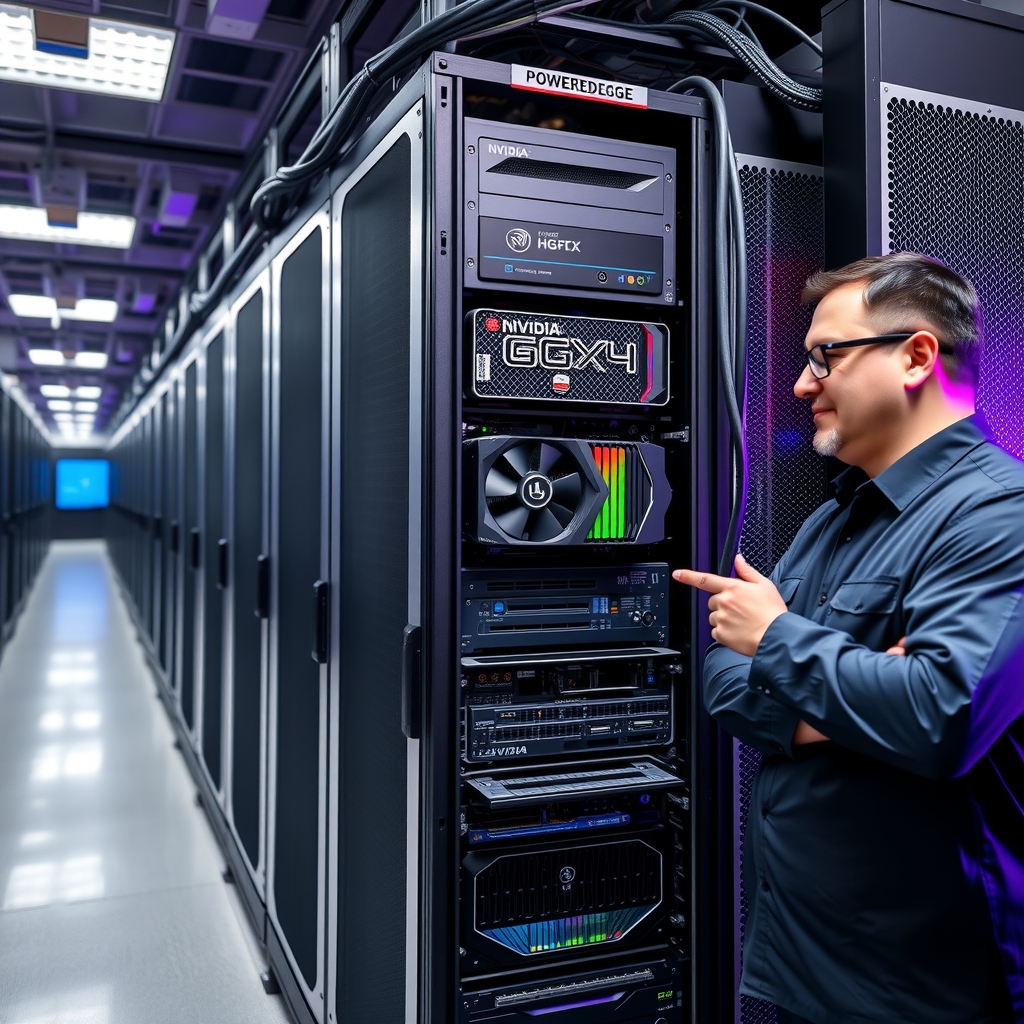
For the newly announced configuration, the compute component is a PowerEdge XE9780 server containing Nvidia HGX B300 GPUs. Microsoft Foundry Local enables customers to run supported AI models on a suitable Azure Local platform. Dell’s announcement extends that capability to its Private Cloud, placing the model workloads within a customer-managed environment.
Dell positions local deployment as a way to retain control over AI data flows. The company says prompts and model responses do not have to leave the customer’s network, which can help organizations keep processing and information within their own environments. The announcement does not provide specific deployment benchmarks or identify a particular model, workload size or performance result for the XE9780 configuration.
Caitlin Gordon, Dell’s vice president for products, said organizations want to use AI near sensitive data and critical operations without adding infrastructure complexity. Dell and Microsoft, she said, are expanding the ways customers can do so on their own infrastructure.
Hardware details and cost claims
Nvidia describes HGX B300 as an eight-GPU data-center platform based on Blackwell Ultra SXM GPUs. The platform is designed for AI training, reasoning, high-throughput inference and high-performance computing. Nvidia’s published specifications cited in the announcement include up to 2.1 to 2.3 TB of HBM3e memory, fifth-generation NVLink and 1.6 TB/s of networking bandwidth.
Dell also points to a cost analysis suggesting that agentic AI deployments on Dell AI Factory with Nvidia infrastructure could reduce total cost of ownership by up to 90 percent compared with cloud API-based consumption over two years. Some configurations in that analysis were estimated to reach break-even in two to three months.
Those figures should not be read as results for the newly announced Azure Local system. The cited analysis was based on a May 2026 paper by Signal65 and Futurum Group, titled “The Economics of Agentic AI,” and assessed three workload categories: AI-assisted knowledge work, AI-enabled sales agents and AI-agent-assisted software development. It included estimated cloud discounts, hardware and energy costs, and covered a range of Dell desktop, laptop and server systems.
The tested systems included Pro Max laptops with GB10 or GB300, T2 workstations with RTX Pro 6000 GPUs, and PowerEdge XE7740 and XE7745 servers. The analysis did not test Dell Private Cloud with Azure Local, the PowerEdge XE9780 or HGX B300 GPUs running Microsoft Foundry Local models. Dell notes that individual results may vary.
The distinction matters for organizations evaluating the new offering: Dell has announced hardware and platform support, but the cost figures come from other configurations and workloads. Buyers will need to assess their own model choices, utilization, energy costs and infrastructure requirements to determine whether local deployment fits their needs.