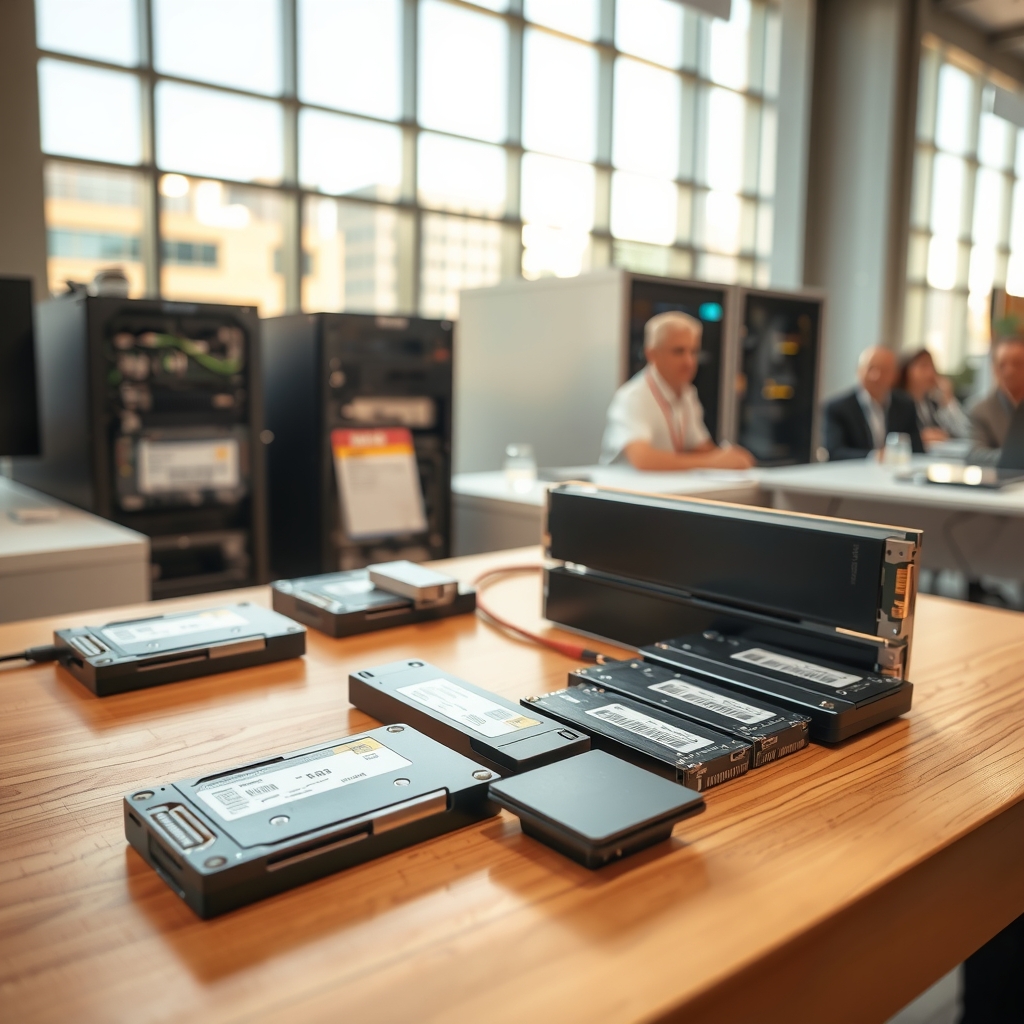
DapuStor used its SC26 booth in Chicago to discuss a broad enterprise SSD lineup, from a 240GB M.2 boot drive to a 512TB QLC drive. Roger Peene, the company’s general manager for the Americas, described the products and development plans in a recorded conversation on November 24, 2026.
The largest drive discussed was the R6060, a 512TB SSD in the E2 form factor. Peene said an E3.L version would follow shortly and that the 512TB drive would sample soon. The product extends a capacity progression that DapuStor has taken from 122TB to 245TB and now 512TB. The company had previously shown the 512TB R6060 at FMS.
Capacity and workload placement
The discussion connected higher drive capacity with rack efficiency and changing AI infrastructure requirements. Brian Beeler raised the importance of terabytes per watt as operators weigh how much power storage consumes relative to other equipment, including GPUs. Peene said larger AI prompts are increasing demand for KV cache and for storage that can take on work otherwise handled by GPUs.
Those pressures also shape how organizations combine flash types. Peene described NAND as part of a memory-to-storage hierarchy, with storage class memory (SCM), triple-level cell (TLC) and quad-level cell (QLC) drives assigned according to workload, power and price. Some customers, he said, are replacing TLC with a smaller SCM tier used as a hot cache in front of higher-capacity QLC drives.
The R6060’s 512TB capacity is relevant to that tiering approach, while the company’s smaller, faster SCM option is aimed at write-intensive tasks. Peene said the combination of memory and an SCM drive can also help extend the capabilities of GPU servers when systems are configured with less RAM. That was presented as a possible system-design approach, not as a universal configuration.
SCM endurance and enterprise use
DapuStor’s X5900P is its storage class memory SSD. Peene said it uses the latest Kioxia NAND and is available in 800GB and 1.6TB capacities, with a 3.2TB version expected to follow. The drive is rated for up to 120 drive writes per day (DWPD), with low latency also central to its positioning.
Peene identified checkpointing and recovery, persistent write buffers and global metadata as uses at high-performance computing sites. Beeler noted that KV cache and checkpointing can generate heavy writes, which puts endurance in focus. The X5900P’s stated rating is a product specification; actual suitability depends on the demands of a particular workload.
Form factors and PCIe Gen6
Server form factors were another topic. Peene said DapuStor initially sampled a 2T E3.S drive, twice the thickness of a 1T model, but found that the market did not want that configuration. The company now has 1T samples available. He said adoption of E2 remains uncertain. DapuStor’s range spans the 240GB M.2 drive through the 512TB R6060.
Peene said DapuStor plans to sample PCIe Gen6 drives next quarter. He expects the interface transition to encourage movement from U.2 toward short and long E3 form factors. Beeler cited read speeds of about 28,000MB/s at the high end for Gen6 drives and noted that the AMD Venice and NVIDIA Vera platforms he had reviewed support the interface.
Peene also listed liquid-cooled drives, inline hardware compression and support for the latest OCP specifications among technologies DapuStor is delivering. The conversation did not provide product specifications or availability details for those capabilities. It also did not identify which Gen6 models will be sampled.
Controller and firmware development
DapuStor develops a controller in-house for part of its portfolio, uses Marvell controllers for other products and writes its own firmware stack, according to Peene. That mix gives the company different controller approaches across its lineup while keeping firmware development internal.
Peene said he would send the 512TB R6060 and a Gen6 drive to Beeler’s lab for testing on Venice and Vera platforms. The planned evaluation may provide more information about real-world performance, but no test results were available in the conversation. For now, the company’s discussion highlights a portfolio spanning dense QLC capacity, high-endurance SCM and upcoming PCIe Gen6 products.