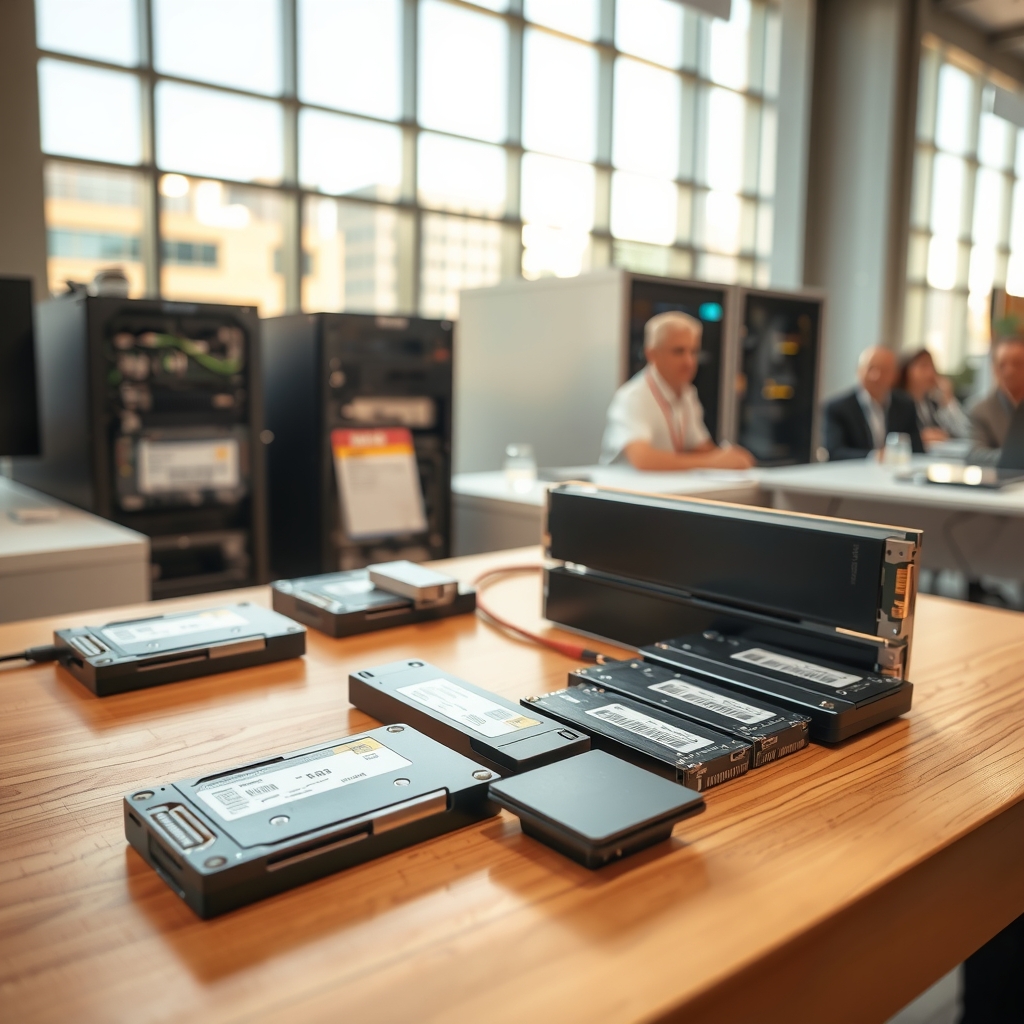

KIOXIA has announced the GP2 Series, a second-generation solid-state drive designed to give GPUs direct access to a high-capacity flash tier. The company rates the drive at more than 18 million random-read IOPS using 512-byte blocks, nearly twice the GP1 Series’ rating of up to 10 million IOPS at the same block size.
The announcement is an early roadmap update rather than a near-term product launch. KIOXIA plans to provide functional evaluation samples to select customers by the end of 2027. The company has not announced a volume-production date, and it cautions that specifications may change before mass production.
Flash tier for GPU-initiated reads
The GP Series is intended to place flash storage alongside GPUs as an additional memory tier, extending the effective capacity of high-bandwidth memory (HBM). Its target workloads involve random reads of small records from datasets that exceed GPU memory, including vector search, graph neural networks and recommendation engines.
KIOXIA says this approach can provide capacity at a lower cost than adding HBM or DRAM while improving GPU utilization. The GP2’s more than 18 million IOPS figure is specified at 512 bytes, the access size KIOXIA identifies for these GPU-initiated workloads. At that block size, the rating equates to about 9.2GB/s.
The drive uses XL-FLASH generation 3, following the second-generation XL-FLASH used in GP1. KIOXIA says the newer media delivers about 2.5 times the random-read IOPS of its TLC-based CM10 Series at 512 bytes, as well as higher endurance and lower power per I/O. Those comparisons are company claims; KIOXIA has not published GP2 power figures.
PCIe 6.0 interface and open specifications
GP2 uses a PCIe 6.0 interface with NVMe 2.3, an update from NVMe 2.2 on GP1. KIOXIA lists sequential reads of up to 28GB/s as an expected figure, based on PCIe 6.0 x4 bandwidth and results from drives still in development. The company says that rate would saturate the link.
Endurance is listed at up to 50 drive writes per day, matching GP1’s stated maximum. GP2 supports direct liquid cooling. KIOXIA is considering E1.S 9.5mm and E3.S form factors; unlike GP1, the current GP2 list does not include the 15mm E1.S option.
Several details remain undisclosed, including capacity, latency, write performance and power consumption. The figures published so far therefore describe selected read-performance and interface targets, not a complete view of the drive’s capabilities or performance in customer systems.
Roadmap and GPU-memory proof of concept
The GP2 plan puts its evaluation samples a year after those for GP1, which are due to select customers by the end of 2026. KIOXIA has not provided production dates for either drive. The GP2 also differs from an earlier direction described by the company: that second-generation concept was a PCIe 7.0 design targeting 100 million IOPS, with a release expected in 2027. GP2 is instead based on PCIe 6.0 and rated above 18 million IOPS. KIOXIA now places the 100-million-IOPS goal with unnamed future generations.
Neville Ichhaporia, senior vice president and general manager of KIOXIA America’s SSD business unit, described GP2 as a step toward the company’s long-term vision of storage reaching the 100-million-IOPS class.
KIOXIA also outlined a proof of concept with NVIDIA using NVIDIA SCADA, a software library for direct GPU access to NVMe drives at small block sizes. The test used a GB200 NVL72 rack with 18 server nodes and 144 KIOXIA XD8 Series 7.68TB E1.S SSDs, eight per node. That configuration provides about 1.1PB of raw flash, with KIOXIA describing nearly 60TB of extended memory per node.
The company says the setup supports 512-byte accesses and could hold a database of 2 trillion such vectors, or about 1PB of vector data. It did not provide throughput or latency results. The demonstration used XD8 drives, not GP Series hardware, and KIOXIA and NVIDIA are continuing to evaluate the technical feasibility and performance of SCADA and the Storage-Next architecture.